Best Promotional Products for Trade Shows in Australia (2026 Guide)
🎪 Why Trade Shows Still Deliver Some of the Best ROI in Promo
Digital ads get skipped. Cold emails get binned. But a branded drink bottle still sitting on someone’s desk three months after a trade show? That’s your logo earning its keep without costing you another cent. Trade shows put you face-to-face with a room full of people who actually showed up because they care about your industry. In 2026, that’s worth a lot — and branded merch is how you make the moment stick.
The trick is not to just rock up with a box of pens and call it done. The businesses that get the most out of trade show merch treat it as a layered strategy — different products for different types of conversations. Someone who stops at your booth for three seconds gets something different to the procurement manager who spends 20 minutes asking detailed questions. Once you get that thinking right, promo products stop feeling like a sunk cost and start pulling their weight properly.
💰 The 3-Tier Trade Show Merch Strategy
This is what separates the exhibitors who get results from the ones who blow their whole budget on 200 premium items and run out by 10am on day one. Three bands: high-volume giveaways, mid-range conversation starters, and premium close items. Each one has a different job. Before you set those bands, read our budget vs premium promotional products guide for the fuller audience, use and lifetime-value framework.
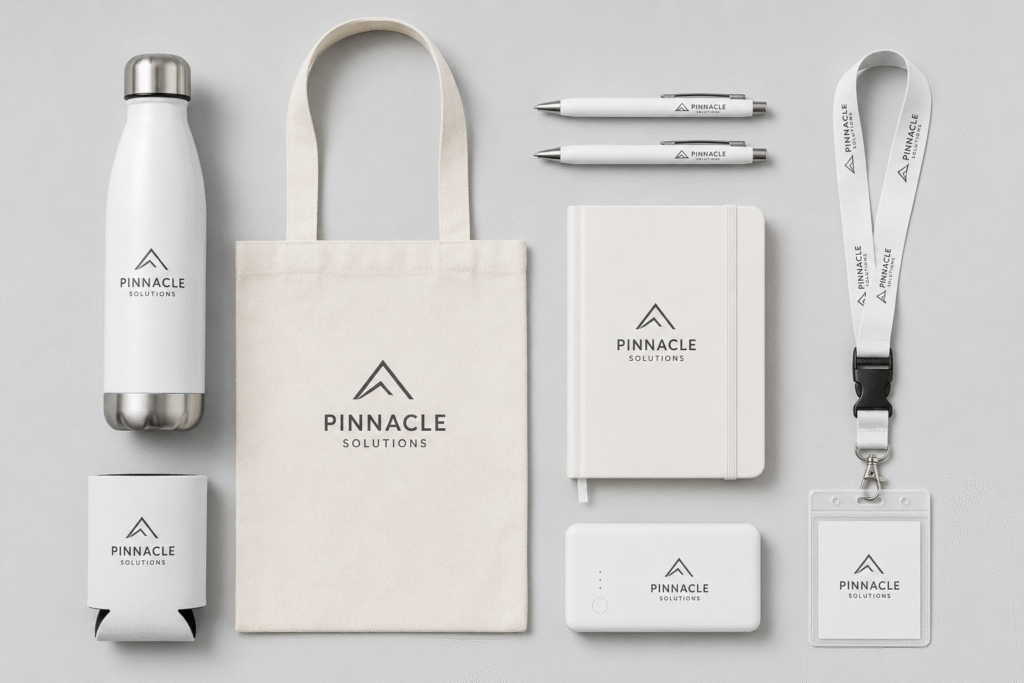
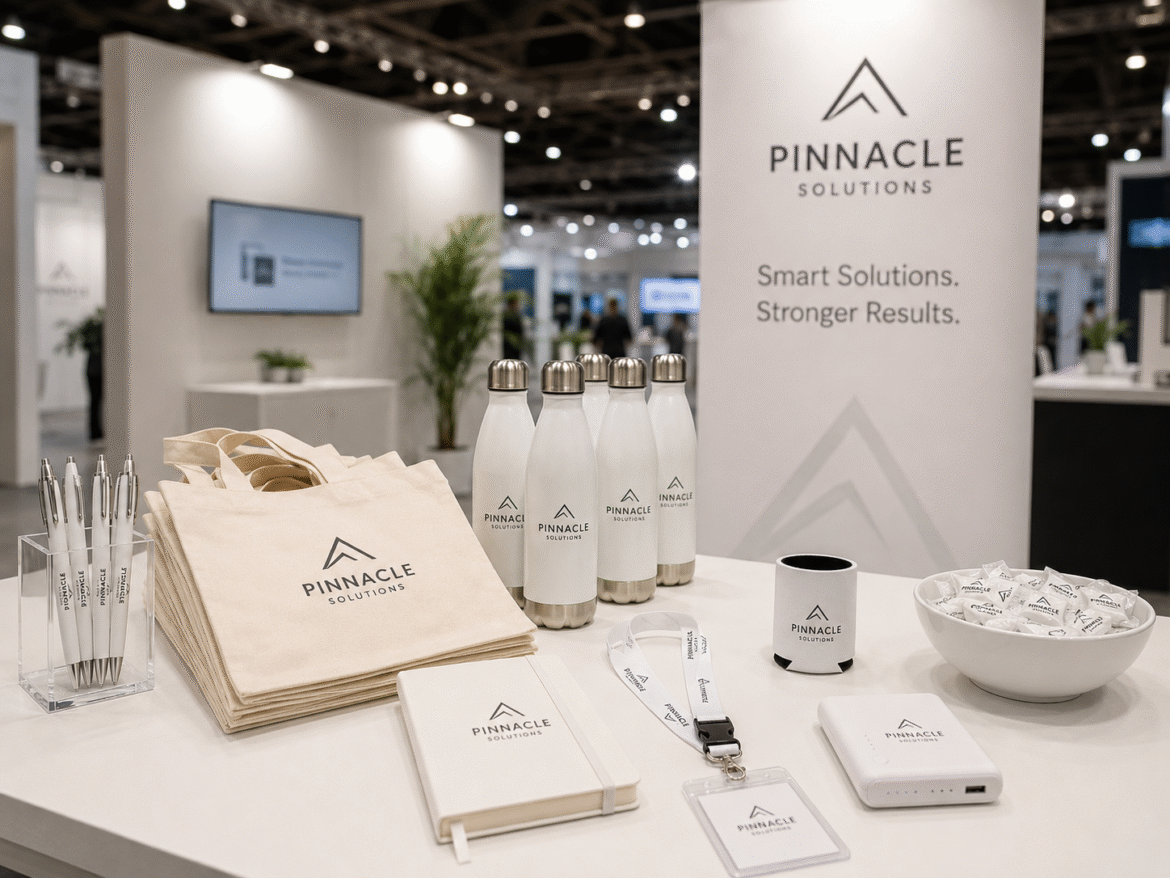
Tier 1 — High-Volume Giveaways (under $3 per unit): These go to everyone who passes your booth. Their job is brand exposure, not lead conversion. Think pens, mints, lollies, stress balls, keyrings, and lanyards. Budget $1.50–$2.50 per unit at quantities of 500+. A branded pen that travels home in someone’s bag or ends up on a colleague’s desk is still doing a job for you weeks later. Mints and lollies are especially good at drawing foot traffic — people stop, you start a conversation.
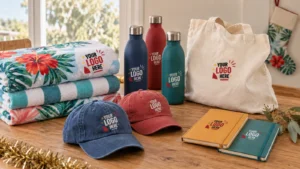
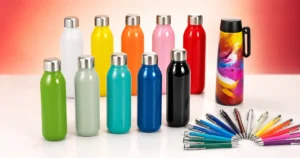
Tier 2 — Mid-Range Items ($3–$15 per unit): For people who’ve had a real conversation with you — they’ve scanned their badge, asked questions, or shown genuine interest. Drink bottles, tote bags, notebooks, stubby holders, and reusable coffee cups sit comfortably in this range. These items have longer daily use — your logo on a coffee cup gets seen every morning. Order quantities of 150–300 depending on expected booth traffic and your follow-up process.
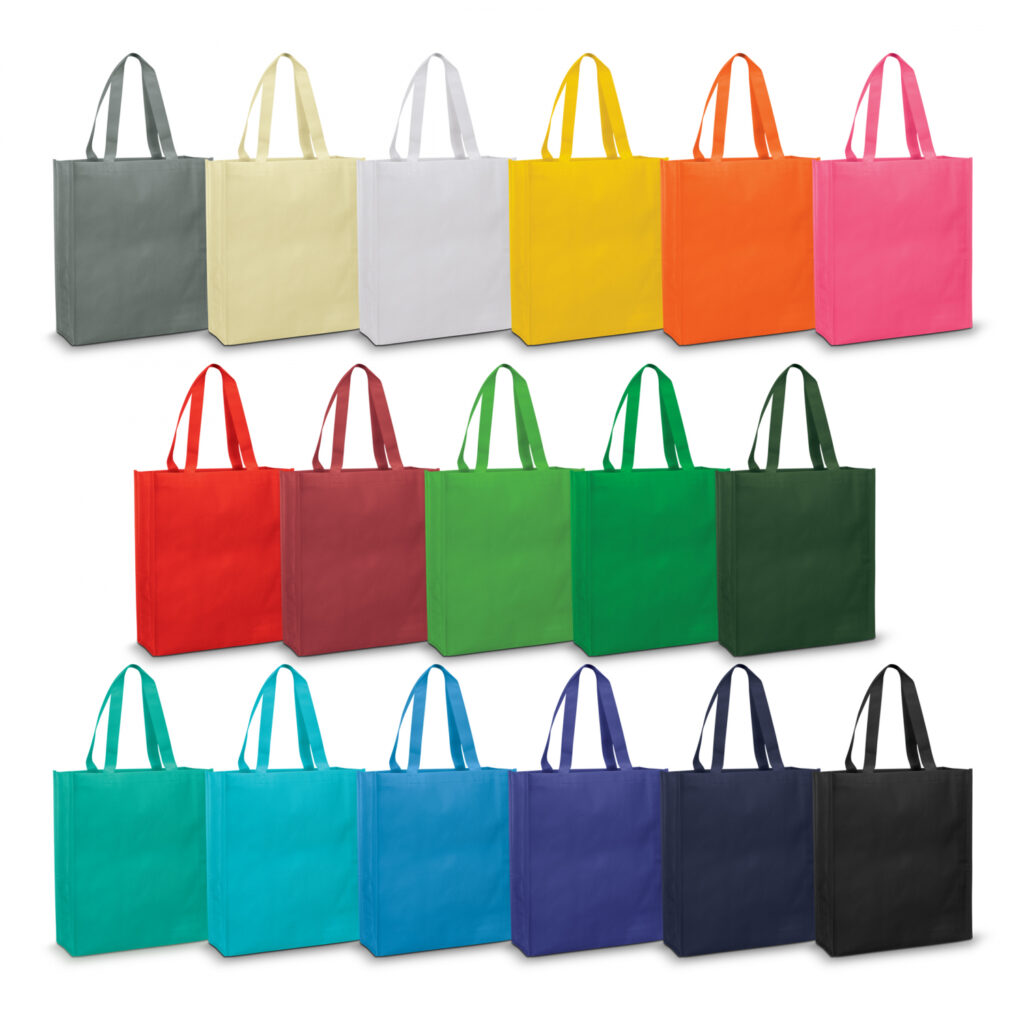
Tote bags work well at trade shows because they are useful on the day and keep your logo moving afterwards. Before choosing one, compare cotton, non-woven, jute and recycled cotton tote bags so the material fits your budget, artwork and the way attendees will use it.
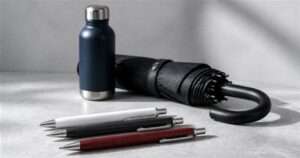
Tier 3 — Premium Close Items ($15–$60+ per unit): Reserved for your hottest leads — the ones you’re already writing proposals for, or VIP clients you want to show you value the relationship. Insulated bottles, branded power banks, quality umbrellas, premium tech accessories. These aren’t giveaways — they’re a closing tool. Order 25–75 units. Having 50 of these is plenty for a 2-day show if your Tier 1 and 2 are doing their job filtering conversations.
🛍️ Solving the Trade Show Bag Problem
Here’s something most exhibitors don’t think about until they’re standing at their booth watching people walk past: attendees need somewhere to put all the stuff they’re picking up. A branded bag handed out early in the day is one of the smartest things you can do at a trade show. Every person who takes one becomes a walking billboard for the rest of the day. Other exhibitors see it. Other attendees see it. And your bag is now the one carrying all your competitors’ flyers too.
Non-woven tote bags start from around $2.50–$4.00 at 300+ units. Reusable calico or cotton totes are pricier at $5–$9 but have far better shelf life — people actually keep and reuse them. If you’re at a show where sustainability messaging matters to your audience, the cotton option is worth the extra spend. At a trade show expecting 1,000+ attendees, having 400–500 branded bags isn’t over-ordering — it’s strategy.
🏗️ Matching Products to Your Industry
What works depends on who you’re handing it to. Here’s a quick breakdown by sector:
Industry Fit Guide:
Mining & Construction: Practical wins every time. Safety-yellow lanyards, stubby holders, heavy-duty keyrings, and insulated bottles for site workers. These get used on-site, not stuffed in a drawer. Avoid anything too delicate — it won’t survive a worksite.
Corporate & Finance: Premium positioning matters. Notebooks with a quality feel, sleek pens, power banks, and insulated travel mugs. Colour-match to your brand if possible. Cheap items can actually hurt your perception in this sector.
Health & Wellness: Drink bottles, reusable coffee cups, and stress balls hit the brief. Anything that signals an active, health-conscious brand. Avoid single-use plastics — it sends the wrong message for this audience.
Education: Pens, notebooks, lanyards, and tote bags are all well-received. High-quantity budget items work well here since you’re often dealing with large volumes of staff and students. Tote bags in particular get heavy use in education settings.
Hospitality & Events: Fun, colourful items. Branded umbrellas (genuinely used in Perth and Brisbane outdoor venues), insulated wine tumblers or stubby holders, and anything that fits the venue aesthetic. Think about the person using it, not just the logo on it.
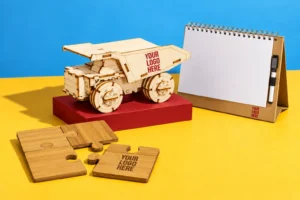
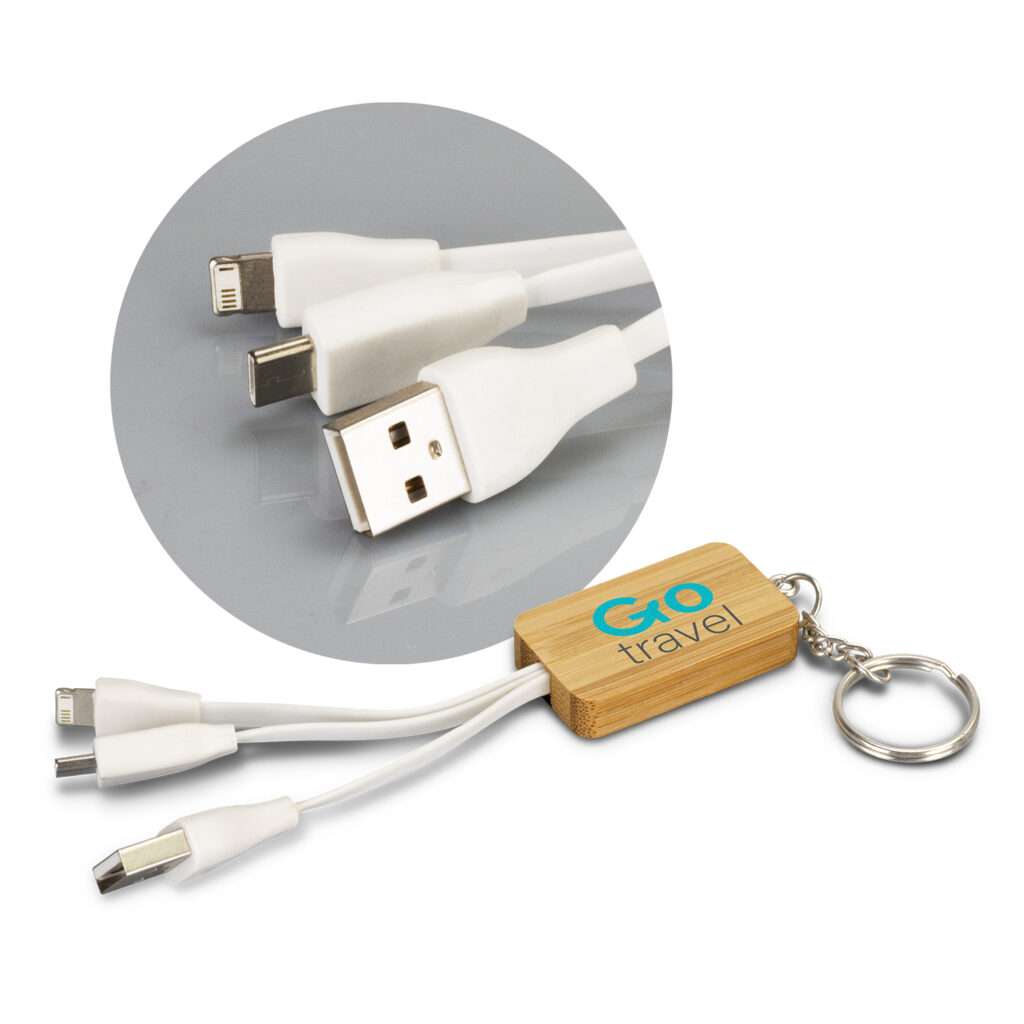
For something that fits your industry, have a look at our unusual promotional products guide. It includes a build-your-own mining truck for machinery businesses, plus compact options such as fidget pens and retractable charging cables for delegate bags.
📦 Quantity Planning: How Many Do You Actually Need?
Order too few and you run out by lunch. Order too many and you’re carting 300 tote bags back to the office (been there). Here’s a rough framework based on foot traffic:
Start with the show’s advertised attendance figure. For a regional industry event expecting 500 attendees over two days, you’re realistically getting foot traffic past your booth of maybe 30–50% of that — call it 200 genuine booth visits if you’re in a good location. From that 200: roughly 80% might take a Tier 1 item (160 units), 25% might be worth a Tier 2 item (50 units), and 5–10% are warm leads worth a Tier 3 item (10–20 units).
For a major national expo expecting 5,000 attendees, scale accordingly — you might budget for 1,500 Tier 1 items, 300–400 Tier 2, and 50–75 Tier 3. Always add a 15% buffer to Tier 1 and 2 to avoid running short. Running out on day one is the worst possible outcome — it signals to anyone who didn’t get something that they missed out, and you lose that brand touchpoint entirely.
One more thing: if you have a corner booth or a large floor presence at a major show, expect higher traffic than average. A small tabletop at a niche industry event will see less. Adjust your formula to the show, not just the headline numbers.
📅 Lead Times: When to Order for Your Show Date
This is where trade show prep falls apart for a lot of people. Leaving it too late is the single most common mistake we see — and it’s completely avoidable. Here’s a realistic guide to lead times for trade show orders:
Standard local stock items (pens, lanyards, basic keyrings): 7–10 business days from artwork approval. These have stock on hand and are branded quickly. In an emergency, rush jobs can sometimes be done in 3–5 business days but expect a premium.
Mid-range items (drink bottles, tote bags, notebooks): Allow 10–15 business days from artwork approval. Some items require import if specific colours or custom specs are needed — that can push to 4–6 weeks.
Premium or custom items (insulated bottles, power banks, umbrellas): 3–6 weeks minimum for in-stock items with branding. Full custom manufacturing from overseas is 10–14 weeks. If you’re planning something bespoke for a major event, start the conversation at least three months out.
The sweet spot for most trade show orders is placing your order 4–6 weeks before the show. That gives you time for artwork approval, production, delivery, and — critically — time to fix any issues without panicking. We’ve sorted plenty of last-minute jobs and we’ll always try our best, but no dramas is a lot easier when there’s time up your sleeve.
🖨️ Branding Methods: What Prints Well on What
The right print method keeps your logo looking sharp. The wrong one makes it flake off by week three. Quick rundown — and our full printing processes page goes deeper if you want the technical detail:
Screen printing is the go-to for tote bags, t-shirts, and fabric items. Excellent colour vibrancy, durable, cost-effective at 100+ units. Works best with solid logos (not photographic detail).
Pad printing is standard for pens, stress balls, and most hard plastic items. Cheap to set up, consistent results, handles small logos well. Usually 1–2 colour — if you have a complex logo, simplify it for this method.
Laser engraving is ideal for metal items — insulated bottles, keyrings, pens with metal barrels. No ink to chip or fade. Gives a premium, permanent look that suits corporate gifting and high-end trade show items.
Digital print / full colour suits notebooks, USB drives, and items where you need gradients or photographic quality. Higher per-unit cost but lets you reproduce complex artwork accurately.
One tip: always supply your logo as a vector file (AI or EPS) if you can. It means cleaner artwork at any size and fewer artwork fees. A PNG at 300dpi can work for digital print, but vector is always preferable.
🚫 Trade Show Merch Mistakes That Cost You
We’ve supplied merch for hundreds of trade shows across Australia. These are the stuff-ups we see over and over — and they’re all avoidable:
Ordering too late. Said it above, saying it again. Rush fees are real and rush options are limited. The show date doesn’t move for you.
Ignoring the bag problem. People need bags. If you don’t give them one, someone else will — and your competitor’s bag carries your flyers out the door. Solve this early.
One-size-fits-all approach. Handing a $50 power bank to someone who wandered past to grab a free pen is wasted spend. The tier system exists for a reason — use it.
Choosing products based on what YOU like. Your audience matters more than your personal taste. A mining safety manager has different preferences to a CBD marketing coordinator. Think about the person receiving it.
If the shortlist is still wide open, our practical guide to choosing promotional products starts with the audience, where the item will be used and the constraints that cannot move. Answer those before filling the three trade-show tiers.
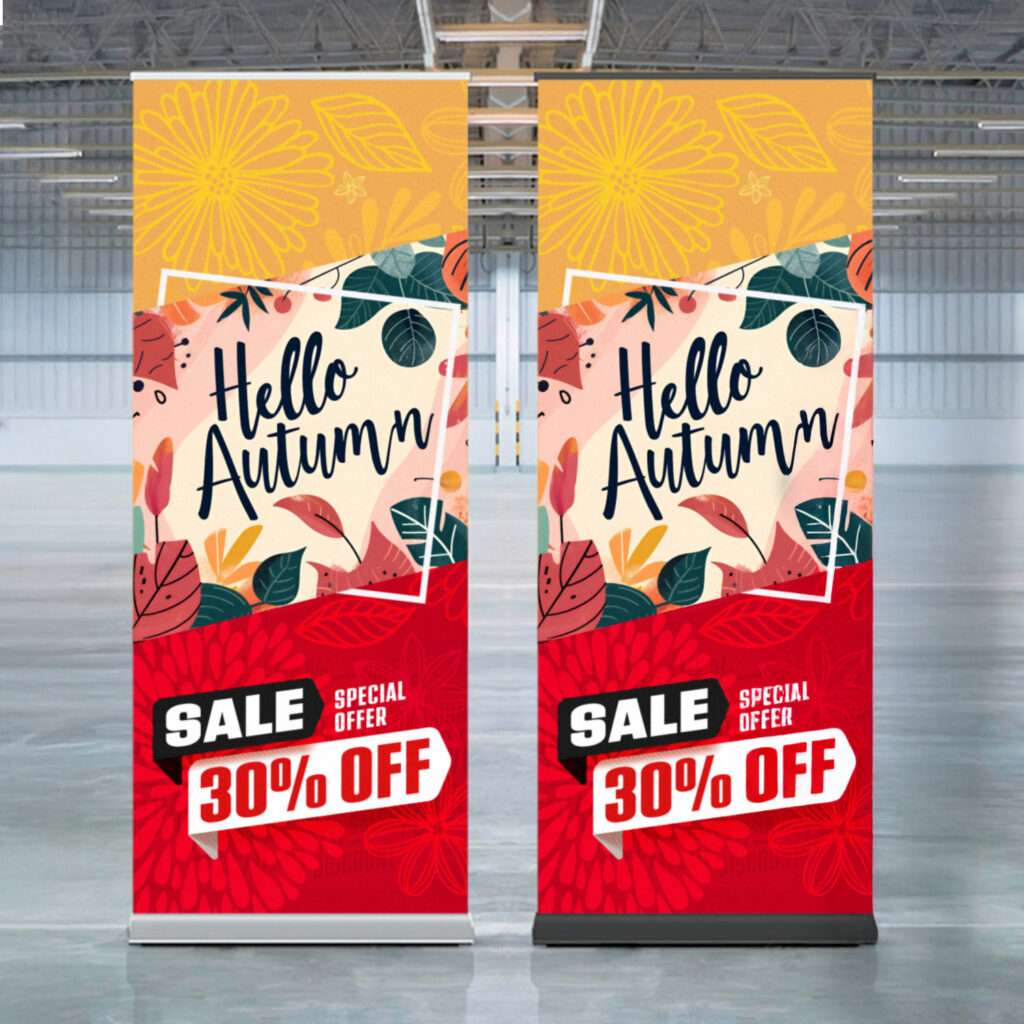
Forgetting booth signage in the budget. Merch is only one piece of the exhibitions & events puzzle. Pull-up banners, tablecloths, and display stands pull the whole booth together. Don’t spend all your budget on products and show up with nothing behind you.
Underestimating freight to venue. Big quantities of branded merchandise are heavy. Factor in freight to the show venue, and make sure your items arrive at least a day before setup — not the morning of.
✅ Trade Show Merch Planning Checklist
Before You Order:
Confirm show date, setup times, and booth size
Get expected attendance figures from the organiser
Set your total merch budget and split across 3 tiers
Identify the right products per tier based on your audience/industry
Confirm logo files are available in vector format
Allow 4–6 weeks minimum lead time from order to show date
Ordering & Production:
Request quotes with quantities for each tier
Approve artwork proofs promptly — delays here cascade
Confirm delivery address: your office or direct to venue?
Check freight cost to venue if not delivering yourself
Order branded bags if you’re going with the bag strategy
At the Show:
Keep Tier 1 items front and accessible — reduce friction to grab
Keep Tier 2 items visible but slightly off the front edge
Keep Tier 3 items behind the desk — only hand out intentionally
Note which products got the most engagement — useful for next show
Reviewed by Daniel Galpin, Co-Founder at PromoMate Australia
15+ years supplying branded merchandise for Australian businesses, events, schools, and trade teams. Focus areas: product selection, print method fit, MOQ planning, and reducing order risk. Meet the team →
🎪 Ready to sort your trade show merch?
Whether it’s your first booth or your fiftieth, we’ll help you put together a product mix that works — on budget, on time, no dramas.
👉 Get a Free Quote →
❓ Frequently Asked Questions
1. How far in advance should I order promotional products for a trade show?
For most standard items, 4–6 weeks before the show is the sweet spot. That covers production, branding, and freight without any stress. Budget items like pens and lanyards can sometimes be turned around in 7–10 business days in a pinch, but for anything mid-range or premium — or if you need custom colours — give yourself at least 4 weeks from when you place the order. The earlier the better, honestly.
2. What’s a reasonable budget for trade show merchandise?
There’s no single answer, but a common starting point is allocating $5–$10 per expected booth visitor across your full product mix. So if you expect 300 genuine conversations across the show, a $1,500–$3,000 merch budget is realistic. Scale up for major national expos or if your average deal size justifies a higher investment per lead. Don’t forget to factor in freight and any display items.
3. What are the most popular trade show giveaways in Australia right now?
Reusable drink bottles, tote bags, and branded pens consistently perform well. Coffee cups have had a big run in the last few years as Australians have become genuinely attached to their reusables. Power banks are well-received as premium items. Anything that solves a real daily problem — carrying stuff, staying hydrated, keeping your phone charged — tends to stick around.
4. Can I get different products delivered directly to the show venue?
Yes, many suppliers including us can arrange delivery to the venue or convention centre directly. You’ll need to coordinate with the venue on freight receiving — most convention centres have specific rules about when and how freight arrives, and some charge handling fees. Confirm all of this well before show week and make sure your boxes are clearly labelled with your company name, stand number, and show dates.
5. What’s the minimum order quantity for most trade show items?
It varies by product. Many pens and basic giveaways have MOQs of 100–250 units. Drink bottles and coffee cups are typically 50–100 minimum. Tote bags often start at 100–150. Premium items like power banks can sometimes be ordered in quantities as low as 25–50. If you’re running a smaller event or need lower quantities, get in touch — we can often find solutions or work across a few product lines to make it work.
6. How do I make sure my logo looks good on the products?
Supply your artwork as a vector file (AI, EPS, or SVG) where possible. This gives the cleanest result at any size, on any surface. If you only have a PNG or JPEG, make sure it’s high resolution (300dpi minimum). We’ll send you an artwork proof before production — always review this carefully and check the logo placement, colour, and size before approving. That’s your last chance to catch anything before it goes to print.
7. Should I brand everything with just my logo, or add other info?
For most items, your logo plus website URL is enough — and sometimes just the logo. Packing in too much text (phone numbers, taglines, slogans) makes items look cluttered, especially on small print areas. The goal is brand recall and easy lookup, not cramming a business card onto a pen. If the item has a larger print area — like a tote bag or notebook — a tagline can work well alongside the logo.
8. What if I need products for multiple upcoming shows?
Ordering in bulk across several shows at once almost always saves you money — both on unit cost and on repeat setup fees. If you’ve got three trade shows across the year, talk to us about ordering your full year’s requirements upfront. We can warehouse stock in some cases, and you’ll lock in better pricing. It also takes the scramble out of each individual show — your merch is already sorted.
Recommended products

- Corporate Christmas Gifts Australia: What to Order (and When) for 2026
 Clients, staff and the long thank-you list each need a different gift. Here’s what to order for Christmas 2026, and when to brief it so it arrives before the office shuts.
- You’ve Been Asked to Sort the Merch. Where Do You Start?Need to sort branded merch? Use three simple questions to choose promotional products for events, staff and clients, then send us your brief for a free proof.
- 8 Unusual Promotional Products People Actually Want to KeepExplore 8 unusual promotional products for Australian teams and clients, with practical branding advice, real product links and free visual proofs.
- How to Choose Promotional Product Colours That Suit Your BrandBold merchandise can look brilliant or completely off-brand. Here is how to choose stock colours, custom PMS products and full-colour decoration with fewer surprises.
- Budget vs Premium Promotional Products: What Actually Earns the Spend?Compare budget, mid-tier and premium promotional products using real PromoMate catalogue examples. Match the item to the audience, use, quantity, artwork and occasion.